
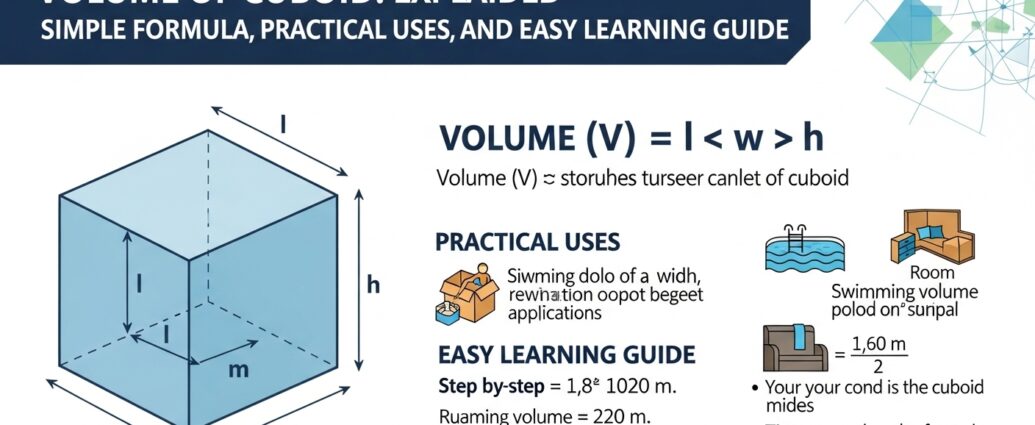
Understanding the volume of cuboid is an essential concept in mathematics that plays a key role in everyday measurements and practical applications. Whether calculating storage capacity, designing structures, or solving academic problems, this concept provides a clear method to determine how much space a three-dimensional object occupies. A cuboid, also known as a rectangular prism, is one of the most common shapes encountered in both real life and geometry. This article explores the concept in depth, offering clear explanations and practical insights to help readers build confidence and accuracy in solving related problems.
What is a Cuboid and Why Its Volume Matters
A cuboid is a three-dimensional shape with six rectangular faces, where opposite faces are equal in size. It has length, width, and height, all meeting at right angles. The volume of cuboid represents the total space enclosed within this shape, making it useful in various real-life situations such as packaging, construction, and storage planning. Understanding how to calculate this volume helps individuals make accurate measurements and efficient decisions. From classrooms to professional fields, mastering this concept ensures that spatial reasoning and measurement skills are both practical and reliable.
The Formula for Calculating Volume of Cuboid
The formula used to calculate the volume of cuboid is straightforward and easy to apply. It involves multiplying the three dimensions of the shape: length, width, and height. This method works because the cuboid is a uniform shape with consistent cross-sections throughout its structure. By understanding how these dimensions interact, learners can quickly solve problems involving space and capacity. This formula forms the foundation of many geometric calculations and is often one of the first volume formulas taught in mathematics education due to its simplicity and wide applicability.
V = l \times w \times h
Understanding Each Dimension in the Formula
Each component of the formula has a specific role in determining the total volume. The length is usually the longest side of the cuboid, while the width represents the shorter horizontal side, and the height indicates the vertical dimension. All three measurements must be in the same unit to ensure accuracy in the final result. When these dimensions are multiplied together, they create a cubic measurement that reflects the total internal space. Recognizing and correctly identifying each dimension is essential for solving problems accurately and avoiding common calculation errors.
Units Used in Measuring Volume of Cuboid
The volume of cuboid is always expressed in cubic units, such as cubic meters, cubic centimeters, or cubic inches, depending on the measurement system used. These units indicate that the measurement accounts for three dimensions rather than just one or two. For example, if the dimensions are measured in centimeters, the volume will be in cubic centimeters. Using consistent units is critical to avoid incorrect results. In practical situations, selecting the appropriate unit depends on the size of the object being measured, ensuring clarity and precision in communication.
Real-Life Applications of Volume of Cuboid
The concept of volume of cuboid is widely used in everyday life, making it more than just a theoretical topic. It is applied in determining the capacity of containers, calculating the amount of material needed for construction, and organizing storage spaces efficiently. For instance, when designing a room, engineers and architects use this concept to estimate space and material requirements. Similarly, in shipping and logistics, it helps in optimizing packaging and transportation. These practical uses highlight the importance of understanding the formula and applying it correctly in various real-world contexts.
Common Mistakes to Avoid in Calculations
While the formula for the volume of cuboid is simple, mistakes can still occur if attention is not given to details. One common error is mixing units, such as using centimeters for one dimension and meters for another, which leads to incorrect results. Another mistake involves confusing the dimensions or misidentifying length, width, and height. Some learners also forget to use cubic units in the final answer. By carefully checking each step and ensuring consistency in measurements, these errors can be avoided, leading to more accurate and reliable calculations.
Tips for Solving Volume Problems Efficiently
Solving problems related to the volume of cuboid becomes easier with practice and a clear approach. Start by carefully reading the question and identifying the given dimensions. Convert all measurements into the same unit before applying the formula. Double-check calculations to ensure accuracy, especially when dealing with large numbers. Visualizing the shape or drawing a simple diagram can also help in understanding the problem better. With consistent practice, these techniques improve speed and accuracy, making it easier to handle both simple and complex volume-related questions.
Difference Between Cuboid and Cube Volume
Although a cuboid and a cube may appear similar, there is a key difference in their dimensions. A cube is a special type of cuboid where all sides are equal, meaning length, width, and height are the same. In contrast, a cuboid has different measurements for each dimension. While the volume formula for both shapes involves multiplication of dimensions, the cube uses a simplified version where one side is multiplied three times. Understanding this distinction helps learners apply the correct formula based on the shape and avoid confusion during problem-solving.
Importance of Learning Volume in Mathematics
Learning about the volume of cuboid builds a strong foundation in geometry and enhances overall mathematical understanding. It develops spatial awareness and helps individuals visualize three-dimensional objects more effectively. This knowledge is not only useful in academic settings but also in various professional fields such as engineering, architecture, and design. By mastering volume calculations, learners gain confidence in solving practical problems and improve their analytical skills. This concept also connects with other areas of mathematics, making it an essential topic for comprehensive learning.
Conclusion
The volume of cuboid is a fundamental concept that combines simplicity with practical importance. By understanding its formula, dimensions, and real-world applications, learners can develop strong problem-solving skills and apply them effectively in everyday situations. Avoiding common mistakes and practicing regularly further enhances accuracy and confidence. Whether used in academic learning or real-life scenarios, this concept remains highly relevant and useful. Mastering it not only improves mathematical abilities but also supports better decision-making in tasks that involve measurement, space, and design.